Refrigerator Repair
Fitting a 42-Inch Built-In Into a 1948 Gregory Ain Kitchen: Openings
Written byYuki TanabeRefrigeration technician — controls and sensors · 18 years in the trade
A 36- or 42-inch built-in wants a framed opening close to 84 inches tall and about 24 inches deep, which no 1948 Gregory Ain kitchen has. Here is what the Mar Vista retrofit really involves, and why an under-ventilated opening books the next service call.
Fifty-two houses in the Mar Vista Tract were completed in 1948 to a single compact floor plan, sold as Modernique Homes and drawn by Gregory Ain with Joseph Johnson and Alfred Day. In 2003 the tract became the first post-war Modern historic preservation overlay zone in Los Angeles. Not one of those kitchens was laid out around a built-in refrigerator, and that is where a good deal of the service history on these streets actually begins.
The question worth asking first
Ask what has to be built before you ask what will fit. A 36- or 42-inch built-in Sub-Zero wants a framed opening close to 84 inches tall and roughly 24 inches deep, dead level and square, with specified clearance for the condenser to breathe and a water line for the ice maker that the original plumbing never ran.
These kitchens were drawn around a late-1940s freestanding unit of roughly 30 to 32 inches wide and about 60 inches tall, standing in the open with air on every side. Getting from that to a modern column means either re-framing an original interior wall or giving up a piece of the open plan the tract is known for. The overlay reviews exterior change, so if the ventilation solution involves putting a new grille or louvre through an outside wall, that is a question for the planning process before the cabinet drawings are finished — not after the appliance is on a truck. The honest description of this job is carpentry and framing first, appliance delivery second.
What shortens an appliance life here specifically
One thing shortens a retrofitted built-in’s life more than anything else in this part of the city: a condenser breathing its own exhaust. Cut an opening to the width of the appliance and no further, and warm air leaving the grille is drawn straight back into the intake. Run time climbs, the off cycle disappears, and everything downstream ages faster.
It is not only the Ain houses. In Cheviot Hills, a column boxed into a 1920s cabinet run with barely a finger of clearance produces the identical fault two decades earlier in the housing stock. In Larchmont Village, where refrigeration is often tucked into a pantry or a service corridor rather than the kitchen proper, the whole small room becomes the condenser’s air supply and the door to it stays shut. In Encino, room ambient climbs through Valley afternoons, so the machine has least headroom on the day it is asked for most. And in Mar Vista, marine air a few miles off the water works steadily on gaskets, hinges and exposed fins; a fin pack that would have coped at full clearance stops coping once it is also loaded with dust.
The complaint that arrives is nearly always one of two: the fresh food side climbing into the fifties while the freezer still holds, or the compressor running without a break through a hot afternoon.
Reading the machine you already own
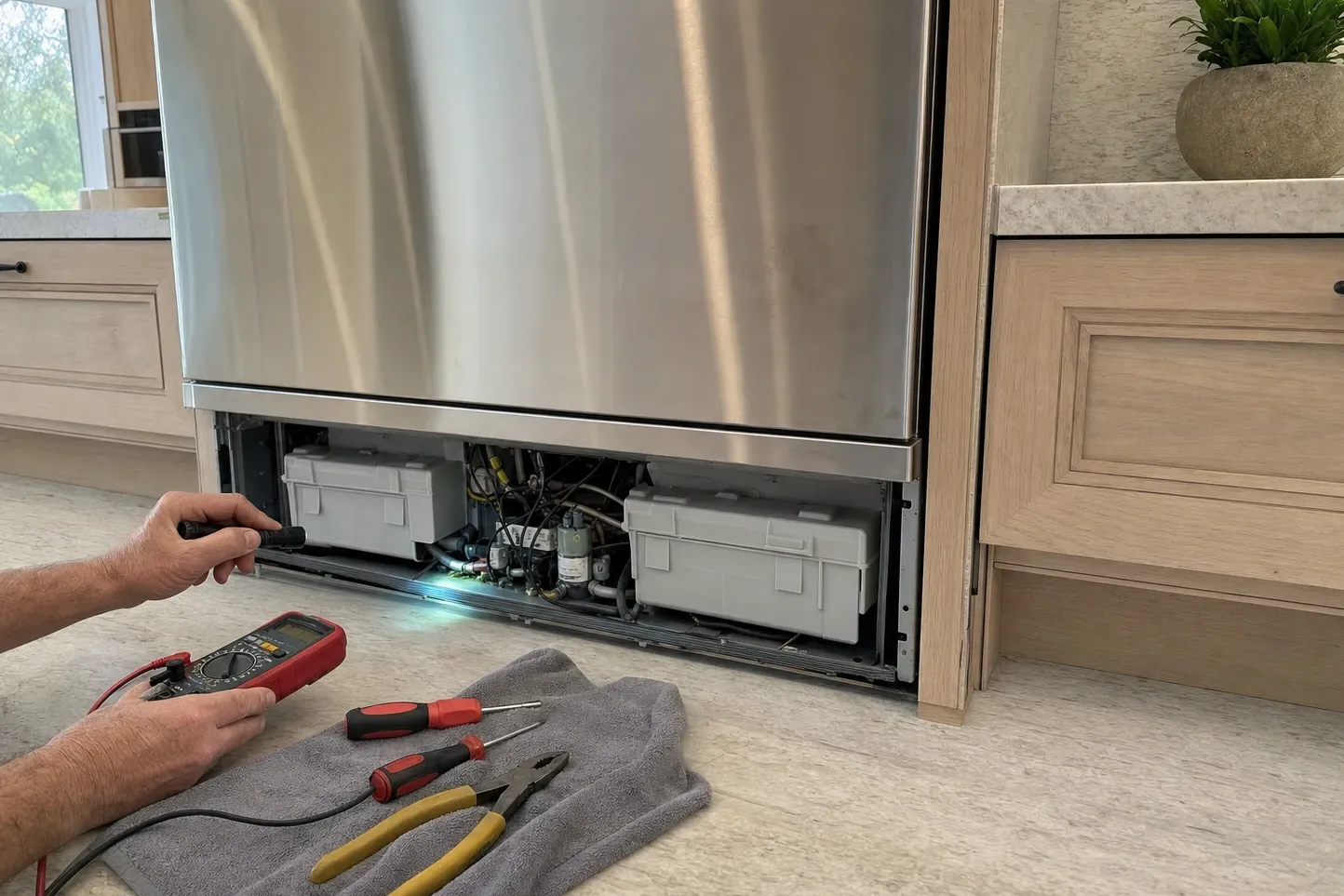
Work the airflow before you work the sealed system. Pull the grille, look at the fin pack, confirm the condenser fan is turning, and find out where its exhaust actually goes. Most units that run constantly and will not hold temperature in a retrofitted opening are describing the opening, not the refrigerant charge.
The order matters, because everything early in it is cheap and everything late in it is not.
- What changed. New cabinet panels, a filler strip, a shelf fitted above the unit, a pantry door that now stays closed.
- Grille off. Fin loading, fan rotation, and whether exhaust is returning to the intake within inches of leaving it.
- Level. Front to back and side to side, with a straightedge, before anyone diagnoses a door easing back open instead of pulling itself shut.
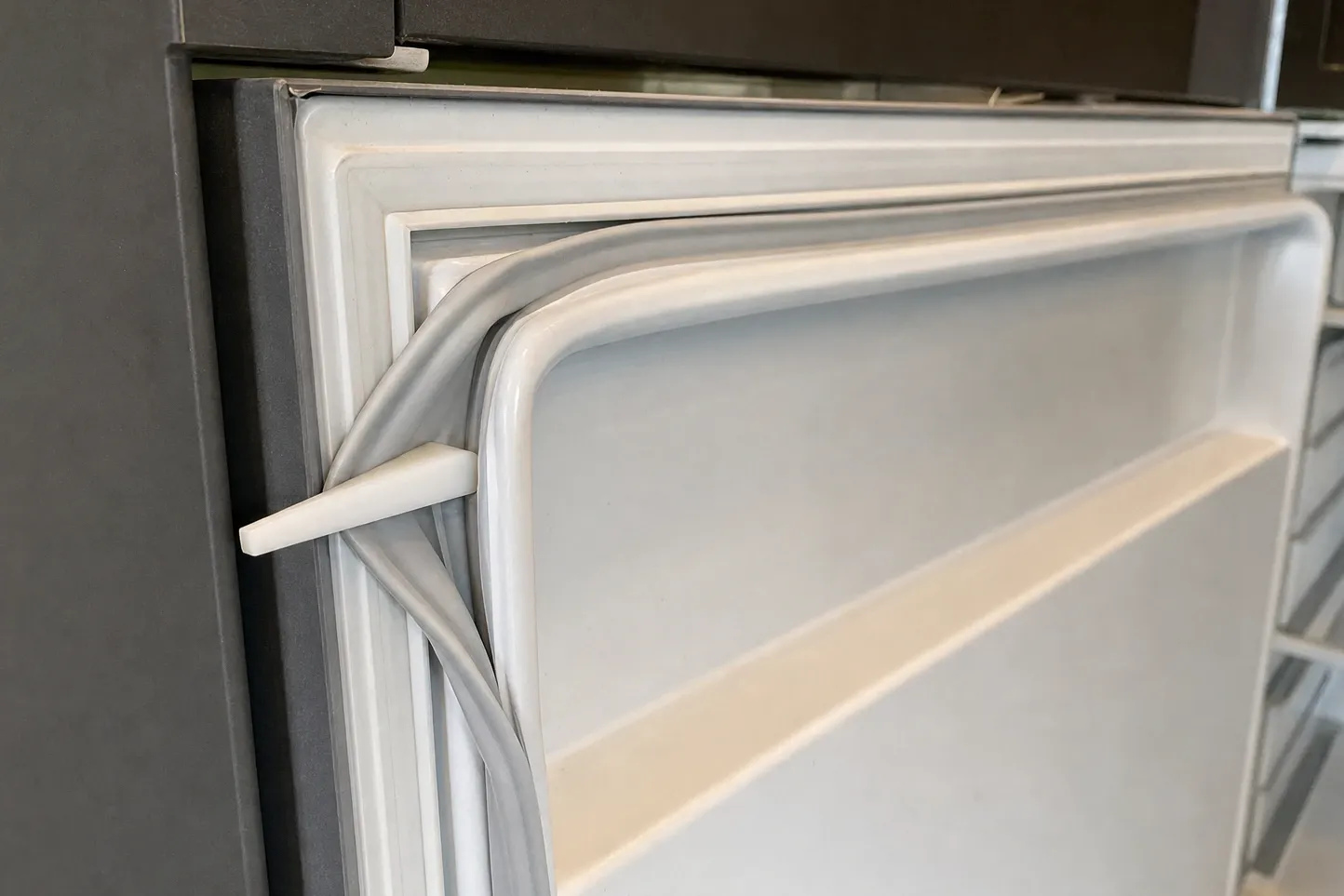
- Seal. Close the door on a strip of paper around the perimeter and find where it slides out without resistance.
- Drain. Water collecting under the produce drawers, or ice across the cabinet floor, points at the drain path and the defrost cycle long before it points at anything expensive.
- Only then compartment temperatures against setpoint, run pattern, and what the unit’s own service data says about all of it.
Repair, or start again
Repair the part when the geometry is right, and fix the geometry when it is not. A fan motor in a properly ventilated opening is a part. The same motor in an opening that recirculates its own heat is a part you will be buying again, on the same appliance, in front of the same cabinet run.
A diagnostic visit is $89. What a retrofit like this tends to need is narrower than the full menu: clearance faults show up first as a fan motor, then as a door gasket that never sealed square in its new opening, and only at the far end as work on the sealed system. Those are the three bands that decide a retrofit, and components fitted are factory-approved parts.
| What the work is | Range |
|---|---|
| Evaporator or condenser fan motor | $330–$750 |
| Door gasket or seal replacement | $260–$690 |
| Compressor or sealed-system repair | $1,510–$3,440 |
The sealed-system band is where the retrofit question gets answered properly. On a unit that has been running near-continuously for years inside a tight box, the useful comparison is not repair against replacement — it is whether that money buys a good machine in a good opening, or an old machine in a bad one. Opening up clearance is often the cheaper half of the work, and it is a carpenter’s job rather than a refrigeration one.
What a diagnosis gives you
You get measurements rather than opinions: the opening as built, the clearance the unit actually has, the state of the fin pack, the level of the case, the condition of the seal, and how the compartments behave across a full run cycle. From that, the faults a part will fix are separated from the faults the cabinetry is causing.
You also get the band your repair sits in before anything is ordered, and a plain answer on whether the opening should be altered while the appliance is out of it — which is far easier than doing it later. Booking is by phone on (310) 844-1973, or through the booking link on this page.
Follow-ups
- Will a 42-inch Sub-Zero fit in a Mar Vista Tract house without changing the floor plan?
- Rarely without framing work. The 52 Modernique houses were completed in 1948 around a freestanding unit of roughly 30 to 32 inches wide and about 60 inches tall, standing in the open. A built-in column needs a framed opening close to 84 inches tall and around 24 inches deep, plus clearance for the condenser and a water line the original plumbing never carried. Something has to be built to hold it.
- My built-in in Cheviot Hills runs constantly and the fresh food side is in the fifties. Is that the compressor?
- Usually not first. In a tight retrofit opening the commonest causes are a condenser pulling back its own exhaust, a loaded fin pack, or a condenser fan that has stopped turning. All three are visible with the grille off in a few minutes. Sealed-system work is the dearest band this site publishes, so airflow deserves to be eliminated before anyone quotes it at you.
- Does the historic overlay affect replacing a refrigerator in the Ain tract?
- The overlay reviews exterior change, so swapping an appliance inside the house is not what it is aimed at. What can involve it is a ventilation fix that puts a new grille or louvre through an outside wall, since the tract has been a preservation overlay zone since 2003. If your plan touches the exterior, ask the planning department before cabinet work is ordered rather than after.