Wine Cooler Repair
Wine cooler running warm: zones, venting and a cabinet with no air gap
Written byYuki TanabeRefrigeration technician — controls and sensors · 18 years in the trade
A Sub-Zero wine unit that will not reach its set point is usually a heat problem before it is a cooling problem. How to tell venting from a failed damper or sensor in a Larchmont or Cheviot Hills cabinet, and what to measure first.
A wine unit does less work than a refrigerator and gets far less attention until the day the display and the room disagree. The complaint is nearly always the same sentence: it will cool to about sixty and no further, and the fan seems to run constantly. In the period houses off Larchmont Boulevard and the twenties builds in Cheviot Hills, that sentence usually has less to do with the refrigeration and more to do with the cabinet it was pushed into.
What the zones are supposed to hold
A dual-zone Sub-Zero wine unit is normally set somewhere around the mid-fifties for reds and the mid-forties for whites and sparkling. It holds those bands with one compressor, a shared evaporator and a damper that decides how much cold air each zone gets — which is the detail that explains most of the faults. The zones are not two independent machines. They are one machine sharing its output on a schedule, so anything that reduces the total cooling available shows up in one zone before the other.
Two consequences follow. First, a single zone running warm does not automatically mean that zone is broken. Second, a unit that cannot reject heat cannot supply either zone properly, however healthy the compressor is.
Heat has nowhere to go
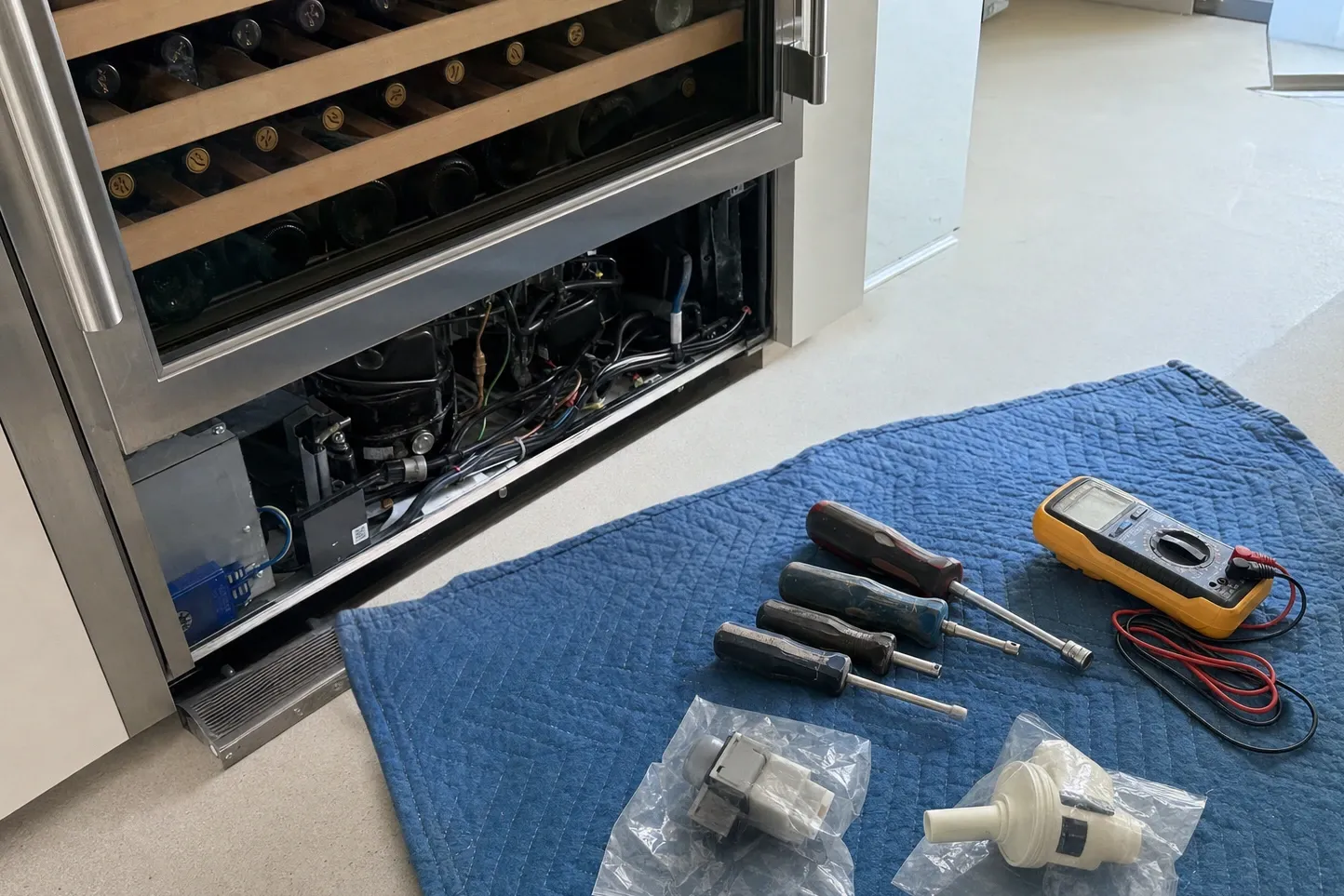
Wine storage is usually built in under a counter or into a run of joinery, and the manufacturer’s clearance is not a suggestion. The condenser sits behind the plinth grille and it needs a path for air in and a path for warm air out. In practice, in older Los Angeles kitchens, that path is often missing:
- a solid kickboard fitted flush across the plinth after installation
- a cabinet built to the exact width of the unit, with no gap at the sides or back
- crates, cases or a doormat stacked against the grille
- a run of joinery with a bench top that seals the top of the cavity
Any of those turns the cavity into an oven. The unit takes the heat it has just rejected straight back in, cycles for longer and longer, and settles at a temperature it can maintain rather than the one you asked for. Nothing has failed; the installation has.
The tell is simple: the machine runs almost continuously, the grille area is noticeably warm to the back of your hand, and the unit does better overnight when the kitchen is cool. That daily pattern is a venting signature. A failed component does not care what time it is.
What it usually turns out to be
Where venting is not the answer, this is roughly the order of likelihood on this route:
| What you see | Where it usually sits |
|---|---|
| One zone several degrees off, the other fine | Damper motor for that zone, or its sensor |
| Frost on bottles at the back of the lower zone | Over-cooling — sensor reading low, or damper stuck open |
| Both zones warm, fan running constantly | Condenser blocked, condenser fan failing, or no air gap |
| Condensation on the inside of the glass | Door seal, hinge alignment, or humidity control in a warm room |
| Hum or buzz carrying into the room above | Compressor mounts, fan bearing, or the cabinet touching the unit |
| Interior light out, display dim, then unresponsive | Low-voltage supply on the control board |
None of those is exotic and none of them needs the sealed system opened. A wine unit that genuinely needs refrigerant work is the minority of the calls — which is worth knowing before agreeing to anything expensive over the phone.
Measure the zone, not the panel
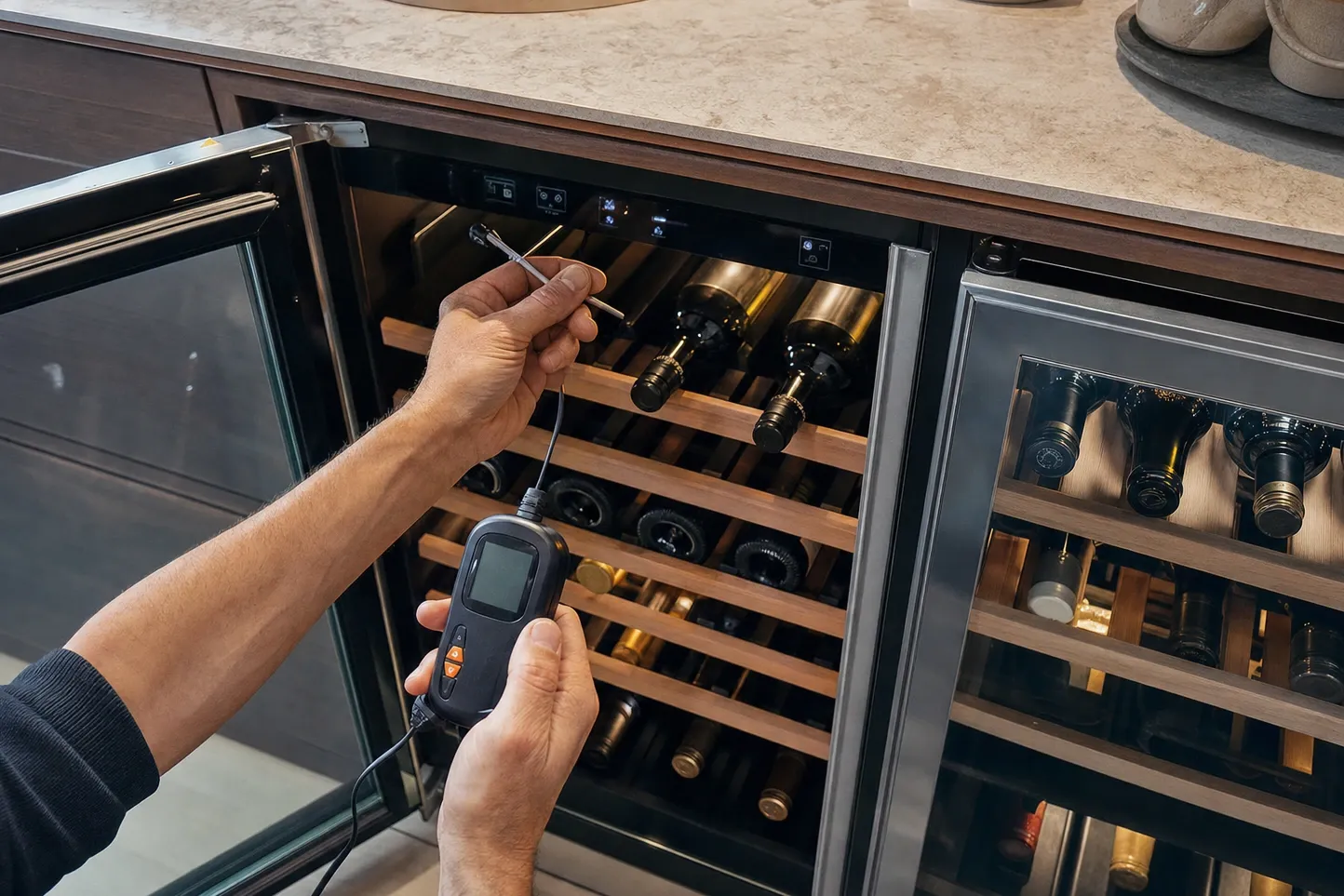
The first thing worth doing, before any part is discussed, is putting a probe on the shelf in the zone that is misbehaving and leaving it there for a few hours. Two readings matter: what the zone actually reaches, and how far it swings between cycles.
- Reads warm, small swing — the machine is doing its best against a heat problem. Look at venting and the condenser.
- Reads warm, large swing — control or damper. The unit is cooling in bursts and not distributing it.
- Reads correct while the panel says otherwise — the sensor for that zone. The wine is fine; the reporting is not.
- Reads colder than the setting — over-cooling, and worth acting on quickly. Frost damage to labels and corks happens quietly at the back of a lower zone.
Do the same in the other zone if you can. Two logs across one evening will tell an experienced ear more than a week of watching the display.
When to call
Call when a zone is more than three or four degrees off its setting and staying there, when you find frost on bottles, when condensation is forming inside the glass, or when the unit has begun cutting out and coming back on its own. Those are all faults that get worse and cheaper to fix early — a stuck damper eventually takes the compressor’s duty cycle with it.
A visit costs $89, which buys the journey out and the whole diagnosis and comes off the work once you approve it. On a boxed-in cabinet the diagnosis often includes a venting recommendation that costs nothing to act on, which is a better outcome than a part that was never the problem.
Follow-ups
- Is 60°F actually harmful to the wine?
- Steady 60°F is not a catastrophe. What does damage is the swing — a unit that cycles between 55 and 68 as the room heats and cools is working the cork and the wine far harder than a cellar sitting warm and still. Drift matters more than the number.
- The upper zone is right and the lower one is not. Does that rule out venting?
- Not on its own. Poor venting starves the whole machine, and on a dual-zone unit the zone with the longer air path usually loses first. But a single zone off on its own does move a damper motor or that zone sensor to the top of the list.
- Can I fix the air gap myself?
- Sometimes. Clearing the grille, taking a kickboard off and getting anything stored against the plinth out of the way costs nothing and occasionally solves it. Cutting a vent into joinery is cabinetry work — worth doing, but not with the unit in place and running.
- Why measure inside when the unit has a display?
- Because the display is the control board telling you what it believes, and a drifting sensor is one of the faults being investigated. A probe on the shelf, logged over a few hours, is the only reading that settles the argument.